Cable Trunking
Cable trunking is a system used to organise and protect electrical cables or wires in buildings and industrial settings. It provides a safe, tidy way to route and conceal cables, improving both the appearance and the safety of an installation. By enclosing cables, it shields them from impact, crushing, and accidental contact with sharp objects, reducing the risk of short circuits, electric shocks, and fires. It also keeps cables from tangling, which makes individual runs far easier to identify and manage during installation, maintenance, or repairs. Cable trunking typically takes the form of a rectangular or square enclosure made of plastic or metal, with a removable or hinged cover that allows easy access to the cables when needed. It is often divided into compartments to separate cables of different types and sizes. Beyond protection and tidiness, concealing cables supportselectrical safety and prevents dust build-up that could become a fire hazard, while some metal trunking adds shielding or grounding to reduce electromagnetic interference.
RS Hong Kong stocks a wide range of cable trunking, from PVC and plastic profiles to open-slot wiring ducts and self-adhesive trunking, to suit projects from a single office fit-out to a full industrial installation.
Types of Cable Trunking
RS Hong Kong offers several types of cable trunking, each suited to a different material need and installation method. The main types are below.
PVC Cable Trunking
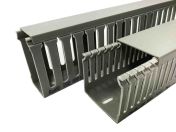
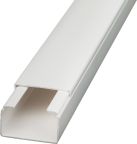
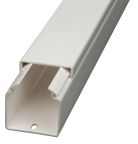
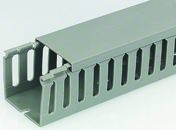
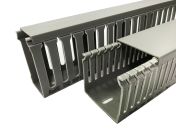
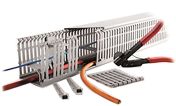
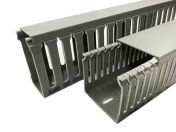
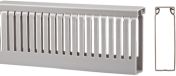
PVC (Polyvinyl Chloride) trunking is the most common type and is widely used across commercial and industrial installations. Affordable, lightweight, and easy to cut and fit, PVC trunking is available in a wide range of sizes, from compact profiles around 15mm wide up to large sections of 200mm and beyond, in colours such as grey and white. This versatility makes plastic cable trunking the default choice for most general wiring, from office fit-outs to control panel building.
Metal Cable Trunking
Metal trunking, usually made of steel or aluminium, offers greater robustness and durability than plastic. Steel trunking in particular provides excellent protection against impact and crushing, and stands up well where fire resistance or mechanical strength is required. For this reason, metal cable trunking is typically specified in heavy industrial settings and areas exposed to higher mechanical stress, where a plastic profile would not offer enough protection.
Adhesive Cable Trunking
Adhesive cable trunking, also known as self-adhesive trunking, comes with a pre-applied adhesive strip on the back. It simplifies installation by allowing the trunking to be directly stuck to walls, ceilings, or other surfaces without the need for additional fixings. Adhesive trunking is commonly used in situations where drilling holes for mounting is not desirable.
Flexible Cable Trunking
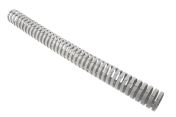
Flexible trunking, typically made of plastic or rubber, is designed to accommodate cables that require bending or routing around corners. Its slotted sides let cables enter and exit easily along the run, which is especially useful in confined or complex spaces such as machine builds and equipment enclosures. This flexibility speeds up both the initial wiring and any later changes, making it a practical form of wire trunking for dynamic installations.
Applications of Cable Trunking
Cable trunking is used wherever wiring needs to be routed safely and neatly. The most common applications are below.
Office and Commercial Buildings
In offices and commercial spaces, cable trunking neatly organises and protectselectrical cables, keeping workspaces tidy while allowing easy access for maintenance and upgrades. Surface cable trunking is ideal here, running power and data along walls, skirting, and desk partitions to reach new workstations without disruptive rewiring or chasing into walls.
Industrial and Manufacturing Settings
On the factory floor, cable trunking provides robust protection for cables against harsh conditions, minimising wear and supportingsafety in industrial working environments. Heavier-duty profiles route machinery wiring and power trunking across the plant, shielding cables from impact, vibration, and contamination where a run failure could halt production.
Residential Homes
In homes, cable trunking helps manage and conceal wiring for a cleaner look, while protecting cables from pets and everyday activities. Compact profiles are popular because they are easy to paint and blend into skirting, and floor cable trunking safely carries leads across rooms to prevent trip hazards.
Data Centres and Server Rooms
In data centres and server rooms, cable trunking keeps critical data cabling organised and supports airflow around dense cable runs, reducing the risk of interference and helping maintain efficient operation. Structured routing also makes moves, adds, and changes far quicker, minimising downtime during upgrades.
Buy Cable Trunking from RS Hong Kong
As a trusted cable trunking supplier in Hong Kong,RS Hong Kong stocks a comprehensive range from leading brands includingRS PRO,Igus,HellermannTyton, andSchneider Electric. From PVC cable trunking and open-slot wiring ducts to self-adhesive and flexible trunking, find the right electrical trunking for the job, in a range of sizes, colours, and fire ratings. Browse and order online. You can also addcable trunking accessories, conduits, and conduit fittings to complete your installation. For full details on delivery services and fees, please refer to ourDelivery page.
715 Products showing for Cable Trunking
In Stock
Subtotal (1 pack of 8 units) HK$612.704 HK$76.588/unit |
In Stock
Subtotal (1 bag of 4 units) HK$139.00 HK$139.00/bag |
In Stock
Subtotal (1 pack of 25 units) HK$1,029.20 HK$41.168/unit |
In Stock
Subtotal (1 pack of 4 units) HK$152.60 HK$38.15/unit |
In Stock
Subtotal (1 pack of 8 units) HK$1,912.504 HK$239.063/unit |
Temporarily out of stock
Subtotal (1 pack of 4 units) HK$403.80 HK$100.95/unit |
Temporarily out of stock
Subtotal (1 pack of 4 units) HK$194.30 HK$48.575/unit |
In Stock
Subtotal (1 pack of 8 units) HK$1,203.00 HK$150.375/unit |
In Stock Subtotal (1 pack of 100 units) HK$6,490.00 HK$64.90/unit |
In Stock
Subtotal (1 bag of 4 units) HK$316.90 HK$316.90/bag |
In Stock
Subtotal (1 bag of 4 units) HK$709.90 HK$709.90/bag |
In Stock
Subtotal (1 pack of 26 units) HK$15,570.698 HK$598.873/unit |
Limited stock
Subtotal (1 pack of 32 units) HK$5,944.096 HK$185.753/unit |
In Stock
Subtotal (1 pack of 4 units) HK$155.40 HK$38.85/unit |
In Stock
Subtotal (1 pack of 4 units) HK$342.60 HK$85.65/unit |
In Stock Subtotal (1 pack of 4 units) HK$368.40 HK$92.10/unit |
In Stock
Subtotal (1 pack of 4 units) HK$200.60 HK$50.15/unit |
In Stock
Subtotal (1 pack of 4 units) HK$462.50 HK$115.625/unit |
In Stock
Subtotal (1 pack of 4 units) HK$409.30 HK$102.325/unit |
In Stock
Subtotal (1 pack of 8 units) HK$1,793.704 HK$224.213/unit |

Popular Searches
Be the first to know about our latest products and offers
Email address
The personal information you provide to us when signing up to this mailing list will be processed in line with the Privacy Policy