Network Switches
Network switches serve as the fundamental interconnectivity layer within modern industrial and enterprise architectures, operating primarily at Layer 2 (Data Link) of the OSI model to facilitate efficient packet switching. Unlike hubs, which broadcast data to all ports, switches utilise Media Access Control (MAC) address tables to direct frames specifically to the intended recipient, thereby minimising collisions and optimising bandwidth utilisation.
In complex automation environments, these devices are critical for ensuring low-latency communication between Programmable Logic Controllers (PLCs), Human-Machine Interfaces (HMIs), and field I/O devices.
RS Hong Kong provides a comprehensive portfolio of high-performance network switches, ranging from entry-level unmanaged units to sophisticated Layer 3 managed switches and ruggedised industrial variants designed to withstand extreme thermal gradients and electromagnetic interference (EMI).
Different Types of Network Switches
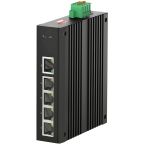
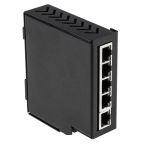
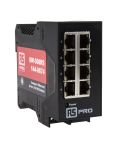
The architectural requirements of a network dictate the specific configuration and port density of the switching hardware. Ethernet network switches are available in diverse form factors, including DIN rail, rack-mount, and desktop configurations, with port counts typically ranging from 5-port and 8-port compact units to high-density 48-port enterprise switches.
Unmanaged Switches
Unmanaged switches are "plug-and-play" devices designed for simple, fixed configurations where network traffic prioritisation is not required. These units lack a management interface and operate with factory-set parameters, making them ideal for edge-level connectivity in small-scale workshops or isolated laboratory environments where cost-efficiency and ease of deployment are paramount.
Managed Switches
Managed switches offer granular control over network traffic through features such as Virtual Local Area Networks (VLANs), Quality of Service (QoS) prioritisation, and Simple Network Management Protocol (SNMP) monitoring. These devices allow engineers to segment traffic, implement redundancy protocols like Spanning Tree Protocol (STP), and perform remote diagnostics, ensuring high availability in mission-critical infrastructures.
PoE (Power over Ethernet) Switches
Power over Ethernet (PoE) switches adhere to IEEE 802.3af/at/bt standards, enabling the simultaneous transmission of data and DC electrical power over a single Category 5e or Category 6 cable. This eliminates the need for localised power supplies at the PD (Powered Device) end, significantly simplifying the installation of IP cameras, wireless access points, and VoIP terminals.
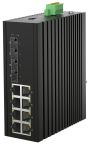
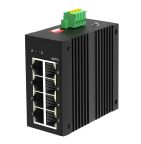
Industrial Ethernet Switches
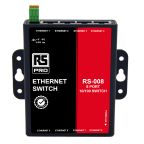
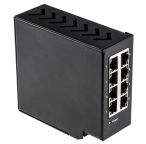
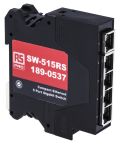
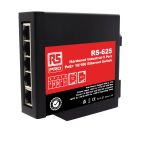
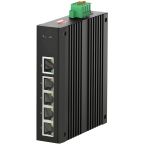
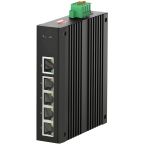
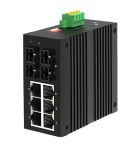
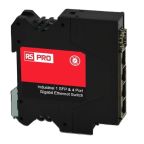
Engineered for the factory floor, industrial Ethernet switches feature hardened enclosures — often with IP30 or higher ingress protection — and lack internal fans to prevent dust ingestion. They are designed to operate across extended temperature ranges and offer enhanced resistance to vibration, shock, and electrical surges, often incorporating redundant DC power inputs to prevent single points of failure.
Applications of Network Switches
The deployment of switching technology is ubiquitous across various sectors, though the functional requirements vary significantly based on the environmental conditions and the nature of the data being transmitted.
Office & Enterprise IT Networks
In corporate environments, switches act as the backbone for Local Area Networks (LANs), connecting workstations, printers, and NAS (Network Attached Storage) units. Managed Layer 3 switches are often employed here to handle inter-VLAN routing, ensuring that departmental traffic remains isolated while maintaining seamless access to centralised resources and high-speed uplink to the core network.
Industrial Automation & SCADA Systems
Within the Industrial Internet of Things (IIoT) framework, switches facilitate real-time deterministic communication between control systems. By utilising Managed Industrial Switches, engineers can implement PROFINET or EtherNet/IP optimisations, ensuring that time-sensitive control packets from a SCADA (Supervisory Control and Data Acquisition) system are prioritised over standard background traffic, thus preventing jitter and latency in closed-loop control processes.
CCTV & Security Surveillance Networks
From large facilities to smart home security systems, modern IP-based surveillance relies heavily on PoE switches to manage high-bandwidth video streams from multiple high-definition cameras. These network switches must support high "PoE budgets" to ensure sufficient wattage is delivered to PTZ (Pan-Tilt-Zoom) cameras or units equipped with integrated heaters and IR illuminators, all while maintaining the throughput required for lossless video recording.
Data Centres & Server Rooms
Data centre switching requires ultra-low latency and massive throughput, often utilising SFP+ or QSFP28 ports for fibre optic connectivity at speeds of 10Gbps, 40Gbps, or 100Gbps. In these environments, switches are deployed in Top-of-Rack (ToR) or End-of-Row (EoR) architectures to aggregate traffic from blade servers and storage arrays, supporting advanced features like link aggregation (LACP) and fabric-level redundancy.
The Leading Supplier and Distributor of Network Switches in Hong Kong
RS Hong Kong is your premier partner for high-performance network switches and industrial communication hardware. We maintain a robust inventory from globally recognised manufacturers such as Siemens, MOXA, and RS PRO. Our range encompasses various port densities and technical specifications at competitive price points, ensuring your industrial Ethernet requirements are met with precision.
Complementing our switching solutions, we provide essential computing components and secondary peripherals — such as industrial SD cards and PoE injectors — to streamline your network deployments. You can buy your rack-mount Ethernet switches, DIN rail network switches, and panel-mount variants through our streamlined online platform. For comprehensive information regarding our procurement workflows, delivery timelines, and logistics costs, please consult our dedicated delivery information page.


Popular Searches
Related links
- Network Hubs
- Networking & Coaxial Cables
- StarTech.com AF221CE-POE-INJECTOR Unmanaged 2 Port Network Switch Power Over Ethernet
- D-Link 5-Port Fast Ethernet PoE Unmanaged Desktop Switch Unmanaged 5 Port Ethernet Switch Power Over Ethernet
- Brainboxes SW-135 PoE Switches 5 Port Ethernet Switch Power Over Ethernet
- Molex IP20 Unmanaged PoE Ethernet Switch Unmanaged 5 Port Industrial Ethernet Switch Power Over Ethernet
- D-Link 28-Port Gigabit Managed PoE Switch Managed 28 Port Network Switch Power Over Ethernet
- D-Link 28-Port Nuclias Cloud-Managed PoE Switch Managed 28 Port Network Switch Power Over Ethernet